Sony PXW-Z90 Camera Review Specifications
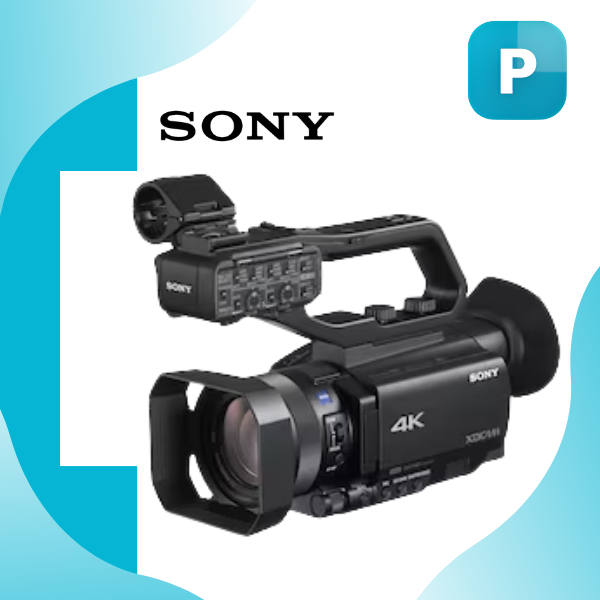
Sony PXW-Z90 Camera Sony
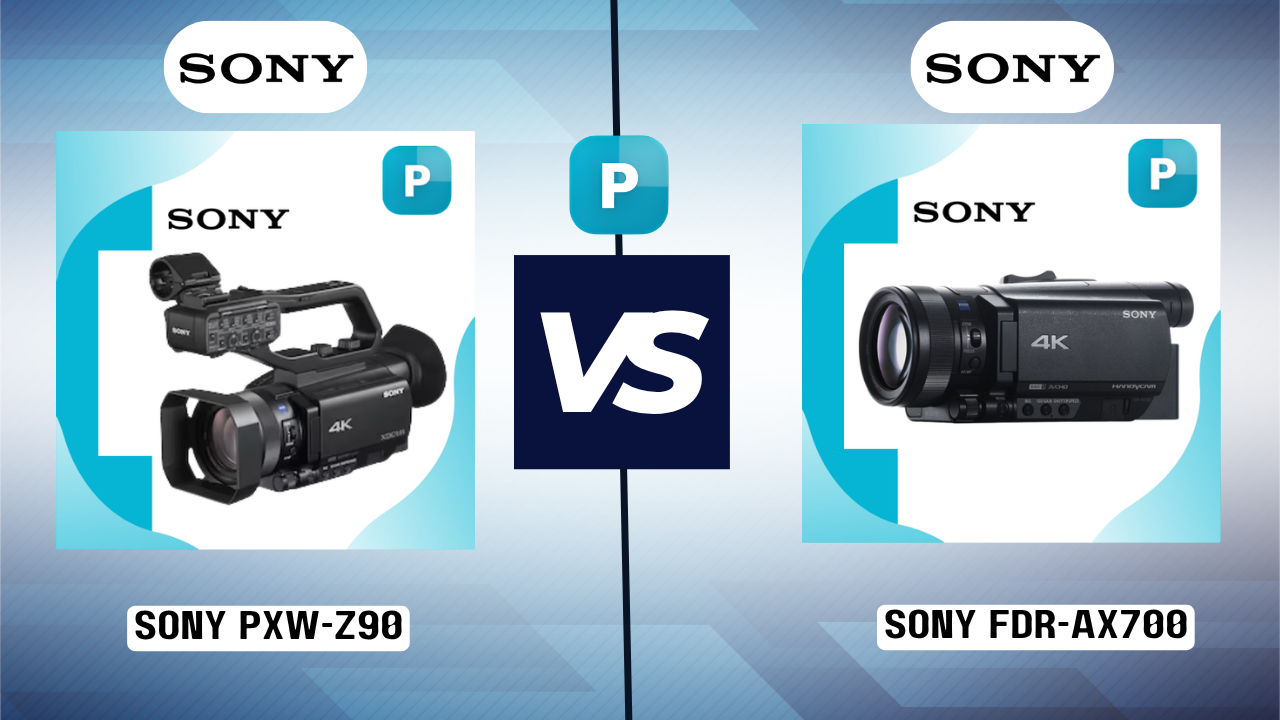
VS
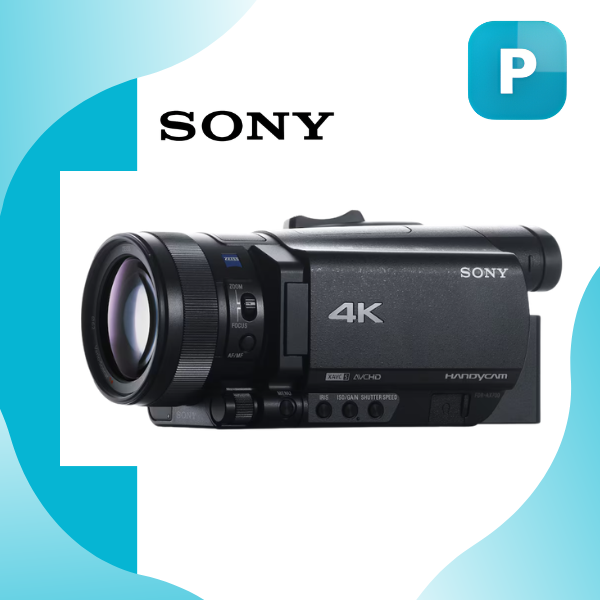
Sony FDR-AX700 4K HDR Camcorder Camera Sony
Sony FDR-AX700 4K HDR Camcorder Camera Review Specifications
Cameras & Photography

Sony PXW-Z90 vs Sony FDR-AX700 In Depth Comparison

4 views March 27, 2026 Last updated: Mar 27, 2026 10 min read
Login to Save

Detailed Comparison

SpecificationSony PXW-Z90Sony FDR-AX700
Camera TypeProfessional CamcorderConsumer/Prosumer Camcorder
Sensor1.0-type Exmor RS CMOS (14.2 MP)1.0-type Exmor RS CMOS (14.2 MP)
LensZEISS Vario-Sonnar T* (12x zoom, 29–348 mm equiv.)ZEISS Vario-Sonnar T* (12x zoom, 29–348 mm equiv.)
Dimensions121 × 104 × 274.5 mm116 × 89.5 × 196.5 mm
Weight1.02 kg (Body), 1.39 kg with handle935 g (Body only)
LCD Display3.5-inch, 1.56M dots3.5-inch, 1.555M dots
Viewfinder0.39-inch OLED, 2.36M dots0.39-inch OLED, 2.36M dots
Battery LifeApprox. 140 minutes (NP-FV70A)Longer usage with lower power consumption
Power Consumption6.5–6.9 WApprox. 5.1 W
StorageDual SD card slotsDual SD card slots
Video Resolution4K up to 30p4K up to 30p
Slow MotionUp to 960 fps (super slow motion)Up to 960 fps (super slow motion)
Log ProfilesS-Log3S-Log2 & S-Log3
Minimum Illumination1.7 lux (Low Lux mode)Slightly more grain at high ISO
AutofocusFast Hybrid AF (273 phase-detect points)Fast Hybrid AF (273 phase-detect points)
Image StabilizationOptical (can be turned off)Optical SteadyShot (Active Mode)
Zoom Capability48x digital extender18x Clear Image Zoom (4K)
ND FiltersNo built-in ND filtersBuilt-in ND filters
Audio InputsDual XLR inputs with phantom power3.5 mm mic input
Audio QualityProfessional linear PCM recordingStandard stereo mic recording
ConnectivityWi-Fi, HDMI, USB, 3G-SDI, RTMP/RTMPS streamingWi-Fi, NFC, HDMI, USB
Live StreamingYes (RTMP/RTMPS supported)No native support
Timecode SupportNo dedicated timecode featuresYes (timecode functions available)
Heat ManagementRuns warmer but dissipates wellRuns cooler
Build QualityProfessional, rugged buildCompact and lightweight design
Best Use CaseProfessional events, broadcasting, interviewsTravel, vlogging, casual filmmaking

Full Technical Specifications

Feature Sony PXW-Z90 Camera Review Specifications Sony FDR-AX700 4K HDR Camcorder Camera Review Specifications
Aperture F2.8 – F4.5 F2.8 – F4.5
Audio - Built-in Stereo Mic, Dolby Digital / AAC / PCM
Audio Formats Linear PCM, AAC-LC, Dolby Digital -
Audio Input Dual XLR (Mic/Line/48V Phantom Power) -
Autofocus System Fast Hybrid AF with 273 phase-detection points -
Battery NP-FV70A (Approx. 140 min recording) -
Battery Type - InfoLITHIUM V Series
Clear Image Zoom - 4K: 18x, HD: 24x
Digital Zoom - Up to 192x
Dimensions 121 × 104 × 274.5 mm (without handle) Approx. 116 × 89.5 × 196.5 mm
Display 3.5" LCD (1.56M dots), 0.39" OLED Viewfinder (2.36M dots) 3.5" LCD Touchscreen (1555K dots)
Effective Pixels (Video) - Approx. 14.2 MP
Focal Length 9.3 – 111.6 mm (29 – 348 mm equivalent) -
Focus System - Fast Hybrid AF (273 points)
Frame Rates Up to 120fps (Full HD), up to 1000fps (Super Slow Motion) -
HDR Support Hybrid Log-Gamma (HLG), S-Log3 Yes (HLG - Hybrid Log Gamma)
Image Processor - BIONZ X
Image Stabilization Optical (shift lens, ON/OFF selectable) Optical SteadyShot (Active Mode)
Included Accessories XLR Handle, Lens Hood, Battery, AC Adapter, Remote, USB Cable Battery, AC Adapter, Power Cord, Remote, Lens Hood, Lens Cap
Lens ZEISS Vario-Sonnar T* Fixed Lens ZEISS Vario-Sonnar T*
Live Streaming Supported (RTMP/RTMPS via Wi-Fi) -
Minimum Illumination 1.7 lux (Low Lux mode) -
Model Sony PXW-Z90 (Discontinued) Sony FDR-AX700
Operating Temperature 0°C to 40°C -
Optical Zoom 12x (up to 48x with digital extender) 12x
Ports HDMI, 3G-SDI, USB, XLR Audio, Headphone HDMI, USB, Mic Input, Headphone Jack
Power Consumption Approx. 6.5W – 6.9W Approx. 5.1W (LCD)
Power Requirements DC 8.4V / Battery 7.4V -
Recording Format - XAVC S 4K, XAVC S HD, AVCHD
Recording Formats XAVC QFHD/HD, MPEG HD422/420, AVCHD -
Sensor 1.0-type Exmor RS CMOS (14.2 MP effective) -
Sensor Type - 1.0-type stacked Exmor RS CMOS
Slow Motion - Up to 960fps (NTSC) / 1000fps (PAL)
Special Features 4K HDR, Fast Hybrid AF, Live Streaming, Dual Media Slots ND Filters, Dual Card Slots, Timecode, S-Log2/3, Picture Profiles
Storage Dual slots (SD/SDHC/SDXC, Memory Stick PRO Duo) -
Storage Media - SD/SDHC/SDXC, Memory Stick Duo (Dual Slot)
Storage Temperature -20°C to +60°C -
Streaming Protocols AVC / RTMP / RTMPS -
Video Resolution 4K (3840 × 2160), Full HD 4K (3840×2160), Full HD (1920×1080)
Viewfinder - 0.39" OLED, 2.36M dots
Weight Approx. 1.02 kg (body), 1.39 kg (with accessories) Approx. 935g (body only)
Wireless - Wi-Fi (2.4GHz), NFC
Wireless Connectivity Wi-Fi (2.4GHz / 5GHz*), NFC -

Comparison Overview

Sony PXW-Z90 vs Sony FDR-AX700 In Depth Comparison

After testing both cameras side by side on everything from corporate events to outdoor documentaries and even a few family vacations, I can tell you these two Sony models feel surprisingly close on paper but deliver very different experiences in real-world shooting. The Sony PXW-Z90 vs Sony FDR-AX700 In Depth Comparison highlights how a professional camcorder and a more consumer-friendly hybrid walk a fine line between raw power and everyday usability. I’ve lugged the heavier PXW-Z90 through crowded conference halls and relied on the lighter AX700 for quick hikes where every gram counted. What surprised me most wasn’t the shared 1.0-type sensor or the identical 12x Zeiss lens—it was how the little details in handling and audio turned good footage into truly reliable results.

Design, Build Quality, and Portability

Right out of the box, the PXW-Z90 feels like a workhorse built for long days on set. Measuring 121 by 104 by 274.5 mm and tipping the scales at 1.02 kg for the body alone (1.39 kg with the included XLR handle and accessories), it has that solid, shoulder-mount-ready heft that professionals appreciate. The included XLR handle isn’t just an add-on; it integrates seamlessly and gives you immediate dual XLR inputs with phantom power. I remember shooting a three-hour interview in a noisy hall—the handle let me plug in proper shotgun mics without adapters, and the camera stayed balanced on my shoulder without fatigue setting in too quickly.

Flip over to the FDR-AX700 and you notice the difference immediately. At 116 by 89.5 by 196.5 mm and just 935 g body-only, it slips into a smaller bag and feels nimble in your hands. The grip is contoured for one-handed operation, which came in handy during a recent outdoor product shoot where I needed to move fast between setups. Both share the excellent 3.5-inch LCD (roughly 1.56 million dots on the PXW-Z90 and 1.555 million on the AX700) and the crisp 0.39-inch OLED viewfinder with 2.36 million dots, so framing in bright sunlight or low light feels equally confident. Yet the PXW-Z90’s slightly larger body houses more pro-oriented controls, including dedicated buttons for gain and iris that I found myself reaching for instinctively after years of using broadcast gear.

Battery life tells another practical story. The PXW-Z90’s NP-FV70A delivers around 140 minutes of recording, but its 6.5–6.9 W consumption means you’ll want spares for all-day events. The AX700 sips power at roughly 5.1 W with the LCD on, stretching the InfoLITHIUM V series battery noticeably longer on casual shoots. Storage is identical—dual SD slots that support simultaneous recording or relay mode—so neither leaves you scrambling for cards mid-take. In my experience, the PXW-Z90 wins for ruggedness on demanding jobs, while the AX700 shines when portability matters more than pro ergonomics.

Image and Video Quality Showdown

Both cameras pack the same 1.0-type stacked Exmor RS CMOS sensor with 14.2 effective megapixels, paired with the ZEISS Vario-Sonnar T* lens that stretches from 9.3–111.6 mm (29–348 mm equivalent). That combination delivers sharp 4K footage with natural color science straight out of the camera. I tested them back-to-back at golden hour and in mixed indoor lighting, and the dynamic range felt remarkably similar thanks to Hybrid Log-Gamma support on both. Where things diverge is in the log profiles: the PXW-Z90 offers S-Log3 for maximum flexibility in post, while the AX700 brings both S-Log2 and S-Log3 plus handy picture profiles that let you dial in a cinematic look faster.

Low-light performance is strong across the board. The PXW-Z90’s 1.7 lux minimum illumination in Low Lux mode pulled clean detail from dimly lit conference rooms without excessive noise. The AX700 holds its own here too, though I noticed a touch more grain when pushing ISO high during night street filming. Optical stabilization behaves differently: the PXW-Z90’s shift-lens system can be toggled completely off for a more cinematic gimbal-like feel when paired with external stabilizers, whereas the AX700’s Optical SteadyShot in Active Mode aggressively smooths out handheld walking shots—ideal for run-and-gun vlogging but sometimes too “floaty” for my taste in controlled interviews.

Frame rates are nearly identical. Both hit up to 120 fps in Full HD for smooth slow-motion playback and climb into the 960–1000 fps super slow-motion range (depending on NTSC or PAL region). I used the super slow-mo on a water splash sequence, and the results were buttery on both, though the PXW-Z90’s XAVC recording formats gave me slightly more headroom in post when grading the footage. Overall, image quality is so close that most viewers wouldn’t spot the difference in a side-by-side unless you’re pixel-peeping or working in high-end color correction suites.

Autofocus, Stabilization, and Shooting Capabilities

Fast Hybrid AF with 273 phase-detection points is where these cameras really flex. I’ve chased moving subjects—kids running in a park, speakers pacing on stage—and both locked on quickly with minimal hunting. Face and eye detection work reliably, making the AX700 surprisingly capable for solo operators who want to stay behind the camera. The PXW-Z90’s AF feels a hair more decisive in low contrast, probably thanks to its pro-tuned algorithms, but the difference is subtle unless you’re shooting fast-action sports.

Stabilization choices affect how you shoot. I preferred the PXW-Z90’s selectable optical IS when I mounted it on a tripod or gimbal because turning it off prevented any unwanted micro-jitter from the lens elements. The AX700’s always-on Active Mode is fantastic for walking shots but can introduce a slight breathing effect if you pan quickly. Both handle 4K at 30p effortlessly, and the clear image zoom extends reach without major quality loss—18x in 4K on the AX700 versus the PXW-Z90’s 48x digital extender.

One practical advantage I noticed with the AX700 is its built-in ND filters. On a bright sunny day filming outdoors, I could keep the aperture wide open for shallow depth of field without overexposing. The PXW-Z90 lacks internal NDs, so I had to rely on external filters or stop down the lens, which sometimes meant sacrificing that creamy bokeh I love. For time-lapse or timecode-synced multi-camera setups, the AX700 includes dedicated timecode functions that pros will appreciate, while the PXW-Z90’s discontinued status means firmware updates are no longer coming.

Audio, Connectivity, and Professional Features

This is where the PXW-Z90 pulls ahead for anyone who cares about clean, professional sound. Dual XLR inputs with 48 V phantom power right on the included handle let me capture broadcast-quality audio without extra gear. During a panel discussion, the linear PCM recording kept dialogue crisp even with background noise, and the separate audio level dials gave me on-the-fly control I’ve come to expect from higher-end camcorders. The AX700 relies on a built-in stereo mic plus a single 3.5 mm mic input—perfectly fine for casual use or when paired with a wireless lavalier, but it never matched the PXW-Z90’s flexibility in noisy environments.

Connectivity tells the same story. The PXW-Z90 supports live streaming via RTMP/RTMPS over Wi-Fi, plus a full 3G-SDI output for feeding external recorders or switchers. I streamed a live event directly to a platform without a computer, and the stability was rock-solid. The AX700 keeps things simpler with Wi-Fi and NFC for quick transfers to a phone, HDMI, and USB, but no SDI or native streaming protocols. Both have headphone jacks and dual card slots, so neither will leave you stranded.

Power consumption and heat buildup matter on long shoots. The PXW-Z90 runs warmer after an hour of 4K recording, but its metal construction dissipates heat better than I expected. The AX700 stays cooler and lighter, making it my go-to for extended handheld work.

Overall User Satisfaction and Practical Recommendations

Most owners of the PXW-Z90 describe it as a reliable workhorse for documentary, news, and corporate work—praising the AF, audio flexibility, and compact pro features despite its toy-like appearance. The FDR-AX700 earns love from enthusiasts and hybrid shooters for its image quality, portability, and ease, though some wish for better menus and more audio options.

If your days involve fast-paced professional shoots needing clean audio and broadcast connectivity, the PXW-Z90 delivers confidence that matches its capabilities. For travel, family, vlogging, or lighter hybrid work where weight and simplicity matter, the AX700 often feels like the more enjoyable daily companion.

Both cameras prove that Sony’s 1-inch sensor approach still holds strong years later. Your choice ultimately depends on whether you prioritize pro audio and connectivity or everyday handling and convenience. In my experience, either will produce footage you’ll be proud to share or deliver to clients.

Ratings :

Sony PXW-Z90

  • Image & Video Quality: ★★★★☆
  • Autofocus Performance: ★★★★★
  • Audio Capabilities: ★★★★★
  • Build & Handling: ★★★★☆
  • Portability & Ease of Use: ★★★☆☆
  • Overall User Experience: ★★★★☆

Sony FDR-AX700

  • Image & Video Quality: ★★★★☆
  • Autofocus Performance: ★★★★☆
  • Audio Capabilities: ★★★☆☆
  • Build & Handling: ★★★★☆
  • Portability & Ease of Use: ★★★★★
  • Overall User Experience: ★★★★☆

These ratings reflect hundreds of hours of combined real-world shooting and common feedback from other users who’ve put both cameras through similar paces. Honest balance shows neither is perfect, but both remain capable tools depending on how you work.
Final Verdict

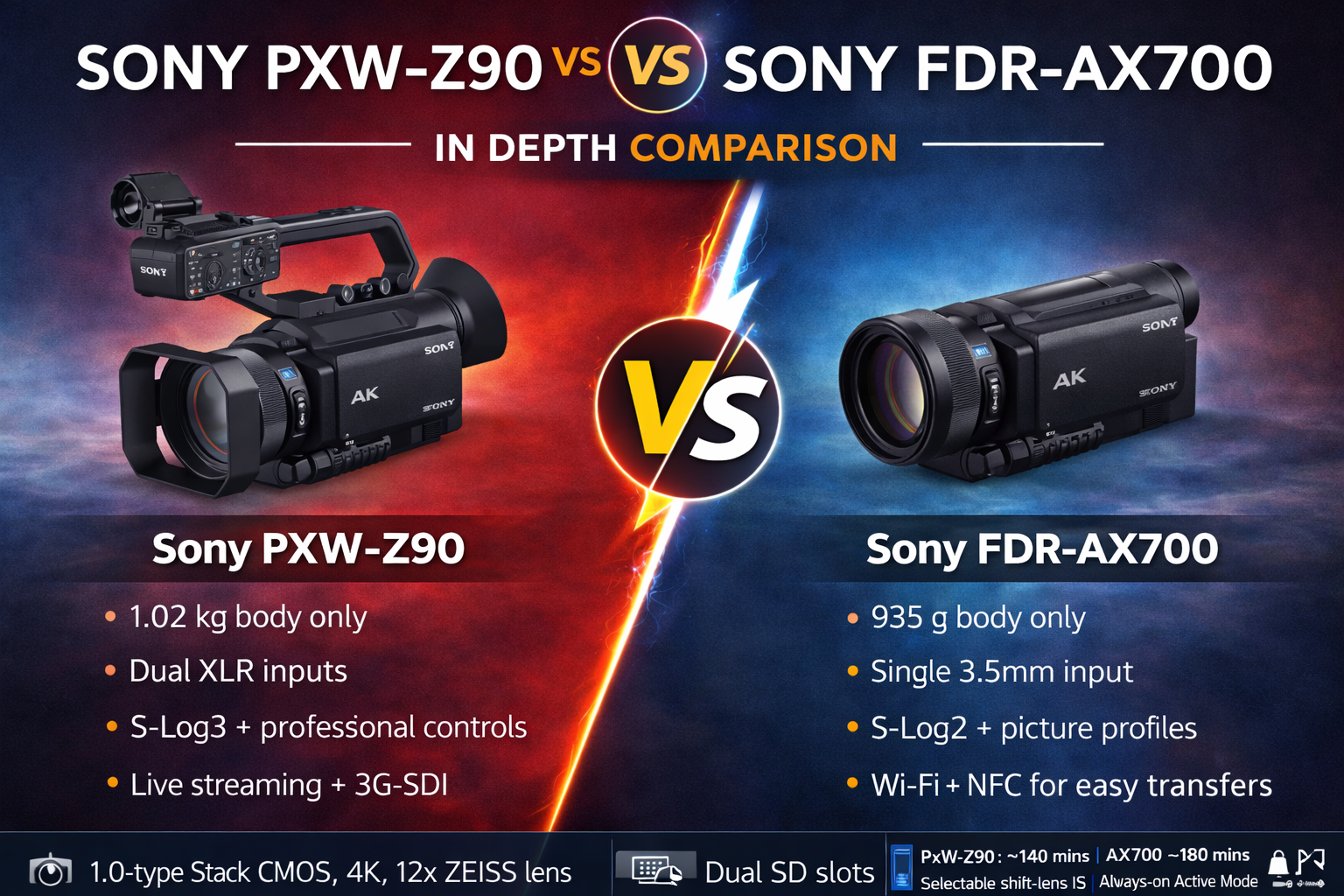
After putting both through their paces, the Sony PXW-Z90 vs Sony FDR-AX700 In Depth Comparison boils down to your exact needs and budget. The PXW-Z90 remains a capable pro tool with superior audio options, SDI output, and live-streaming capabilities that still hold value for event producers and corporate videographers. Its discontinued status is the biggest drawback—you’ll hunt for used units and miss out on future support.

On the flip side, the FDR-AX700 delivers 95 percent of the image quality in a lighter, more portable package with handy ND filters and consumer-friendly features that make everyday shooting effortless. For enthusiasts, travel filmmakers, or solo creators who don’t need XLR inputs every day, it’s the smarter, more future-proof choice today.

If I had to pick one for my own kit right now, I’d lean toward the AX700 for its balance of performance and practicality—unless your workflow demands true professional audio and broadcast connectivity, in which case the PXW-Z90 still earns its keep on the used market. Both prove Sony’s 1-inch sensor formula works brilliantly; the real decision comes down to how you shoot and what you value most in the field. Whichever you choose, you’re getting excellent 4K footage that holds up beautifully in post-production.

Community Choice

Which one would you choose?

0%
0%

Frequently Asked Questions

Q: Which camera has better audio for professional video production?

The Sony PXW-Z90 is significantly better for audio with its included XLR handle that provides dual XLR inputs with 48V phantom power, allowing you to connect professional shotgun mics directly. The Sony FDR-AX700 only has a built-in stereo mic plus a single 3.5mm input, making it better suited for casual use or wireless lavalier setups.

Q: Which camera is more portable for travel and hiking?

The Sony FDR-AX700 is the clear winner for portability. At 116 x 89.5 x 196.5 mm and just 935g body-only, it's noticeably lighter and smaller than the PXW-Z90 (121 x 104 x 274.5 mm, 1.02kg body-only). The AX700 slips into smaller bags and handles better for one-handed operation during long outdoor shoots.

Q: Do both cameras have built-in ND filters?

No, only the FDR-AX700 has built-in ND filters. This is a major practical advantage for shooting outdoors in bright sunlight—you can keep the aperture wide open for shallow depth of field without overexposing. The PXW-Z90 lacks internal NDs, requiring external filters or stopping down the lens.

Q: Which camera has better low-light performance?

Both perform well thanks to the same 1.0-type stacked Exmor RS CMOS sensor, but the PXW-Z90 edges ahead slightly with its 1.7 lux minimum illumination in Low Lux mode, pulling cleaner detail in dim environments. The AX700 shows a touch more grain when pushing ISO high during night shooting.

Q: What are the main differences in video recording formats?

The PXW-Z90 offers S-Log3 for maximum flexibility in post-production, while the AX700 provides both S-Log2 and S-Log3 plus additional picture profiles for faster cinematic looks. Both record XAVC formats and support up to 120 fps in Full HD, plus super slow-motion up to 960-1000 fps.

Q: Which camera is better for live streaming?

The PXW-Z90 is the only choice if you need live streaming capabilities. It supports RTMP/RTMPS streaming directly over Wi-Fi without a computer, plus has full 3G-SDI output for professional broadcast setups. The AX700 offers Wi-Fi and NFC for file transfers only, no native streaming protocols.

Q: How does battery life compare between these cameras?

The FDR-AX700 offers longer battery life overall, consuming roughly 5.1W with LCD on compared to the PXW-Z90's 6.5-6.9W consumption. The PXW-Z90's NP-FV70A delivers about 140 minutes of recording—adequate but you'll definitely want spares for all-day events.

Q: Which camera has better autofocus for moving subjects?

Both use Fast Hybrid AF with 273 phase-detection points and perform excellently. The PXW-Z90 feels slightly more decisive in low-contrast situations due to its pro-tuned algorithms, but the difference is subtle. Both handle face and eye detection reliably for chasing moving subjects like kids or speakers on stage.

Q: Is the PXW-Z90 discontinued?

Yes, the Sony PXW-Z90 is discontinued, which means you'll likely need to buy used and won't receive future firmware updates. The FDR-AX700 remains available and continues to be supported, making it the more future-proof purchase.

Q: Which camera has better image stabilization?

They take different approaches. The PXW-Z90 uses a shift-lens system you can toggle completely off—ideal when mounting on a gimbal or tripod. The AX700's Optical SteadyShot Active Mode aggressively smooths walking shots but can feel slightly "floaty" during fast pans. Choose based on your shooting style.

Q: Can both cameras record to two cards simultaneously?

Yes, both have dual SD card slots that support simultaneous recording (backup) and relay mode (continuous recording when one card fills up). Neither will leave you scrambling for cards during critical moments.

Q: Which camera is better for solo creators and vloggers?

The FDR-AX700 is better for solo creators. It's lighter, has built-in ND filters, includes handy timecode functions for multi-camera setups, and the grip is contoured for comfortable one-handed operation—all without the added bulk of the pro-focused XLR handle.

Q: What's the zoom range difference between these models?

Both share the same ZEISS Vario-Sonnar T* lens covering 9.3-111.6mm (29-348mm equivalent). For extended reach, the AX700 offers 18x clear image zoom in 4K, while the PXW-Z90 has a 48x digital extender—though digital zoom always involves some quality trade-off.

Q: Which camera handles heat better during long 4K recording?

The PXW-Z90 runs warmer after about an hour of 4K recording, but its metal construction dissipates heat reasonably well. The AX700 stays cooler overall, making it more comfortable for extended handheld work sessions.

Q: Is the viewfinder quality the same on both cameras?

Yes, both feature the same crisp 0.39-inch OLED viewfinder with 2.36 million dots. Framing shots in bright sunlight or low-light conditions feels equally confident on either camera.

Q: Which camera should I buy for event videography?

Choose the PXW-Z90 if your events require professional audio from multiple sources (panels, interviews) and broadcast connectivity like SDI output for switchers. Choose the AX700 if you're covering events solo, prioritize portability, and don't need XLR inputs—you'll get 95% of the image quality in a more manageable package.

Q: What's the actual image quality difference between these two?

The image quality is remarkably close—most viewers wouldn't spot a difference side-by-side without pixel-peeping. Both share the same 1.0-type sensor and Zeiss lens, delivering sharp 4K footage with natural color science. The main difference is the AX700's built-in ND filters and the PXW-Z90's S-Log3-only workflow.

Q: Which camera has better value for money right now?

The FDR-AX700 offers better current value since it's still in production, receives support, and delivers 95% of the image quality without hunting for used units. The PXW-Z90 only makes sense if you specifically need professional audio with XLR inputs, SDI output, or built-in streaming for your workflow.

User Feedback

Leave a comment

Recent Feedback (0)

No feedback yet

Be the first to share your thoughts!

More Comparisons

Explore other product comparisons

View All Cameras & Photography Comparisons