TV & Smart TV

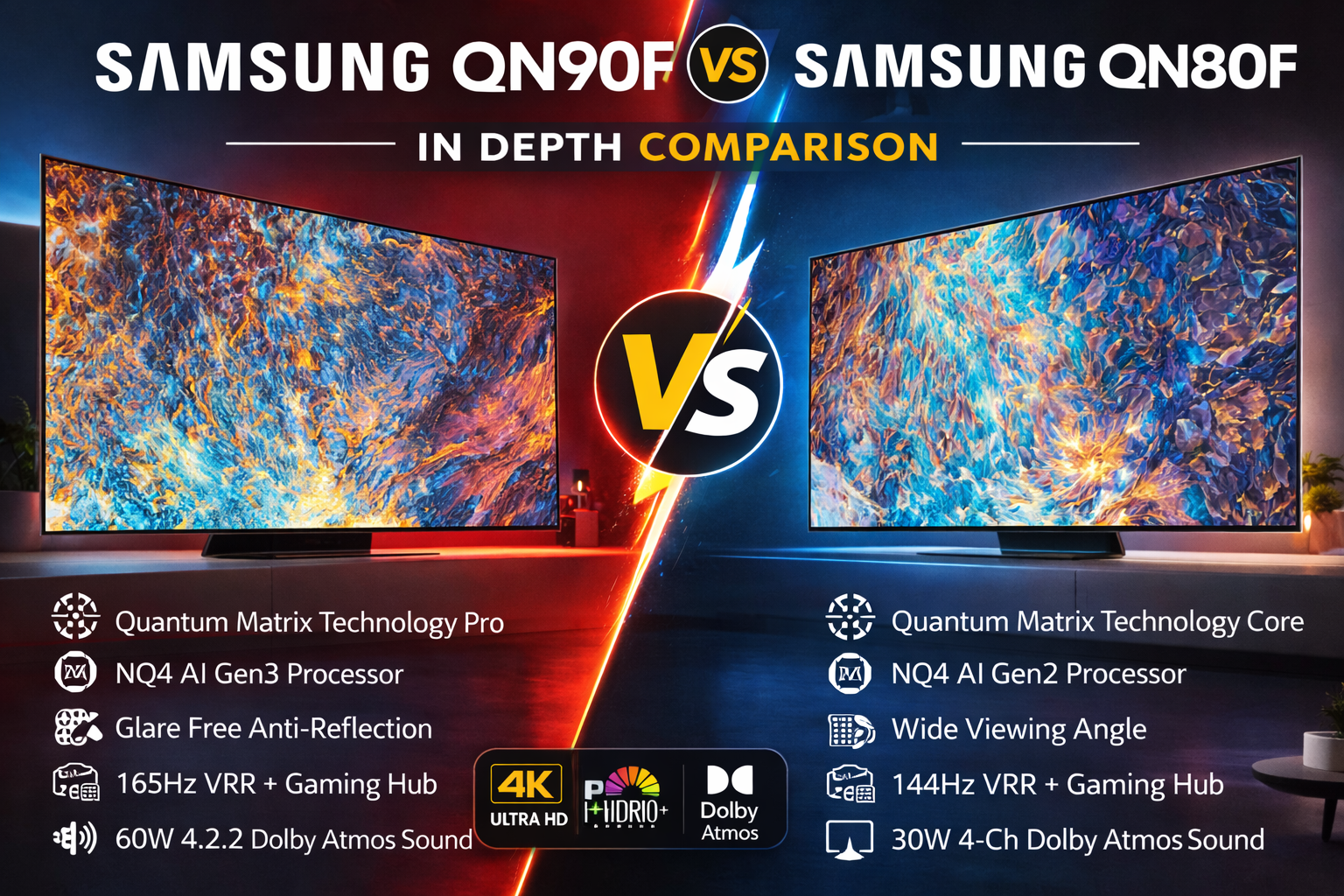
Samsung QN90F vs Samsung QN80F In Depth Comparison

10 views March 16, 2026 Last updated: Mar 16, 2026 10 min read
Login to Save

Detailed Comparison

SpecificationSamsung QN90FSamsung QN80F
Display TechnologyNeo QLED with Quantum Mini LEDNeo QLED with Quantum Mini LED
ProcessorNQ4 AI Gen3 Processor (NQ8 AI Gen3 on 115-inch)NQ4 AI Gen2 Processor
HDR SupportNeo Quantum HDR+Neo Quantum HDR
Backlight TechnologyQuantum Matrix Technology ProQuantum Matrix Technology Core
Refresh Rate120Hz native, up to 165Hz with Motion XceleratorUp to 144Hz with Motion Xcelerator
Upscaling4K AI Upscaling Pro4K AI Upscaling
Anti-ReflectionGlare Free Anti-Reflection CoatingWide Viewing Angle with basic reflection handling
Audio Output60W30W
Speaker Configuration4.2.2 Channel4 Channel
Dolby AtmosYesYes
Object Tracking SoundObject Tracking Sound Plus (OTS+)Object Tracking Sound Lite
Voice EnhancementActive Voice Amplifier ProActive Voice Amplifier Pro
Gaming FeaturesFreeSync Premium Pro, VRR, AI Auto Game ModeFreeSync Premium Pro, VRR, Auto Game Mode
Gaming Refresh CapabilityUp to 165HzUp to 144Hz
Smart PlatformTizen OSTizen OS
Voice AssistantsBixby, Amazon AlexaBixby, Amazon Alexa, Google Assistant
Smart Home IntegrationSmartThings Hub built-inSmartThings support
Wireless ConnectivityWi-Fi 5, Bluetooth 5.3Wi-Fi 5, Bluetooth 5.3
Ports4 HDMI, 2 USB-A, Optical, eARC4 HDMI, 2 USB-A, Optical, eARC
DesignNeoSlim Design with 4 Bezel-less displaySimple Chamfer Design with 3 Bezel-less display
Stand TypeSharp Neck Hexagon StandAero Center Stand
Available Sizes43" – 115"55" – 100"
VESA Mount400 × 300 mmUp to 600 × 400 mm
Typical Power Consumption140W (Max 250W)Up to 390W
Standby Power0.5W0.5W

Full Technical Specifications

Feature Samsung QN90F Class Neo QLED Reviews Specifications Samsung QN80F Class Neo QLED TV Reviews Specifications
360 Audio Support - Yes
AI Features AI Motion Enhancer Pro, Auto HDR Remastering Pro -
Adaptive Sound - Adaptive Sound Pro
Anti Reflection Glare Free -
Apple AirPlay - Yes
Audio Technology - Dolby Atmos
Available Screen Sizes - 55", 65", 75", 85", 100"
Available Sizes 43", 50", 55", 65", 75", 85", 98", 115" -
Bezel - 3 Bezel-less
Bezel Type 4 Bezel-less -
Bluetooth Bluetooth 5.3 Bluetooth 5.3
Built-in Voice Assistants - Bixby, Alexa, Google Assistant
Color Technology Color Booster Pro Color Booster Pro
Contrast Enhancer - Real Depth Enhancer
Contrast Technology Quantum Matrix Technology Pro -
Country of Origin - Mexico
Design NeoSlim Simple Chamfer
Display Technology Quantum Mini LED Quantum Matrix Technology Core (Mini LED)
Dolby Atmos Yes -
Ethernet 1 LAN Port 1 LAN Port
Eye Comfort Mode - Yes
Filmmaker Mode - Yes
Front Color Titan Black Titan Black
Game View Options - Super Ultra Wide Game View, Mini Map Zoom
Gaming Features FreeSync Premium Pro, VRR, Game Bar, AI Auto Game Mode Auto Game Mode, Game Motion Plus, VRR, FreeSync Premium Pro
Gaming Hub Yes Yes
HDMI ARC - eARC
HDMI Ports 4 4
HDR Enhancement - Auto HDR Remastering
HDR Support Neo Quantum HDR+, HDR10+, HLG Neo Quantum HDR, HDR10+, HLG
Included Accessories SolarCell Remote, Power Cable, User Manual -
Micro Dimming - Supreme UHD Dimming
Model - Samsung QN80F
Motion Technology Motion Xcelerator 165Hz Motion Xcelerator 144Hz
Object Tracking Sound OTS+ OTS Lite
Operating System One UI Tizen Tizen Smart TV
Operating System Updates - Up to 7 Years
Optical Audio Out 1 1
Package Weight 74.1 lb -
Picture Processor NQ4 AI Gen3 Processor (43"–98"), NQ8 AI Gen3 Processor (115") -
Picture Upscaling - 4K AI Upscaling
Power Consumption (Max) 250W 390 W
Power Consumption (Typical) 140W -
Power Supply AC110-120V ~ 50/60Hz AC 110-120V ~ 50/60Hz
Processor - NQ4 AI Gen2 Processor
Product Type Neo QLED TV Neo QLED TV
Q-Symphony - Yes
Refresh Rate 120Hz (Up to 165Hz) 120Hz (Up to 144Hz)
Resolution 4K (3840 × 2160) 4K (3840 × 2160)
Smart Home Integration - SmartThings Hub Built-in
Smart Home Support SmartThings Hub Built-in -
Smart TV Platform Tizen Smart TV -
Sound Output 60W 30W
Speaker System 4.2.2 Channel -
Speaker Type - 4 Channel Speakers
Stand Type Sharp Neck Hexagon Aero Center Stand
Standby Power 0.5W 0.5 W
USB Ports 2 x USB-A 2 x USB-A
Upscaling 4K AI Upscaling Pro -
VESA Mount 400 × 300 mm 600 × 400 mm
Viewing Angle - Wide Viewing Angle
Voice Assistants Bixby, Amazon Alexa -
Voice Enhancement Active Voice Amplifier Pro Active Voice Amplifier Pro
Web Browser - Yes
Weight with Stand 60.6 lb -
Weight without Stand 53.4 lb -
Wi-Fi Wi-Fi 5 Wi-Fi 5

Comparison Overview

Samsung QN90F vs Samsung QN80F In Depth Comparison

When shopping for a premium Neo QLED television that delivers stunning visuals, smooth motion, and immersive audio without breaking the bank, many buyers narrow their choices to high-end Samsung models. In this Samsung QN90F vs Samsung QN80F In Depth Comparison, we dive deep into every aspect of these two exceptional 4K TVs to help you make an informed decision. Both belong to Samsung’s Neo QLED lineup, using Mini LED backlighting for excellent contrast and brightness, yet they differ significantly in processor power, refresh rates, sound systems, and overall refinement. The QN90F stands as a flagship-level option with cutting-edge upgrades, while the QN80F offers strong value for everyday viewing and gaming. Whether you prioritize cinema-quality pictures in a sunlit living room or dynamic gameplay on a console, this long-form review breaks down real-world performance differences based on their core specifications. By the end, you will clearly see which TV better matches your needs for picture sharpness, audio depth, smart features, and long-term usability.

Design and Build Quality Face-Off

Samsung has always excelled at sleek television designs, and these two models continue that tradition with subtle but meaningful variations. The QN90F adopts a NeoSlim profile that feels incredibly thin and modern, paired with a 4 bezel-less frame finished in elegant Titan Black. Its Sharp Neck Hexagon stand provides stable support while keeping the footprint minimal, making it ideal for floating shelf setups or narrow media consoles. Available in an impressive range of sizes from 43 inches all the way up to a massive 115-inch panel, it caters to everything from compact bedrooms to dedicated home theaters. The VESA mount measures 400 × 300 mm on most variants, and the overall weight stays manageable even on larger screens thanks to efficient engineering. Power consumption is kept in check with a typical draw around 140W and maximum of 250W, which helps keep electricity bills lower during marathon viewing sessions.

In contrast, the QN80F features a Simple Chamfer design with a 3 bezel-less display that still looks premium but feels slightly thicker around the edges. Its Aero Center Stand offers a clean, centered base that works well on wider furniture. This model comes in 55-inch to 100-inch sizes, skipping the very smallest and largest options available on the QN90F. The VESA mount expands to 600 × 400 mm for the bigger variants, reflecting its focus on mid-to-large rooms. Standby power is identical at 0.5W, but maximum consumption reaches 390W, suggesting it draws more energy under peak brightness. Both TVs include a SolarCell remote and user manual in the box, yet the QN90F’s lighter weight without the stand (around 53 lb on a 65-inch model) makes wall mounting or repositioning noticeably easier. If you value a ultra-slim aesthetic and broader size flexibility for any room layout, the QN90F clearly pulls ahead in design refinement. However, the QN80F’s simpler stand might appeal more to users who prefer a traditional centered look without extra angles.

Picture Quality and Performance Breakdown

Picture performance sits at the heart of any premium TV purchase, and here the differences become most apparent through advanced processing and backlight technology. The QN90F employs the newer NQ4 AI Gen3 Processor (with NQ8 AI Gen3 on the 115-inch version), which powers superior 4K AI Upscaling Pro and Auto HDR Remastering Pro. Its Quantum Mini LED backlight combined with Quantum Matrix Technology Pro delivers deeper blacks and brighter highlights, while Neo Quantum HDR+ support enhances every scene with richer dynamic range. The 120Hz native refresh rate can ramp up to 165Hz using Motion Xcelerator technology, ensuring buttery-smooth action in fast-paced sports or video games. Additional perks like Glare Free anti-reflection coating, AI Motion Enhancer Pro, and Color Booster Pro keep the image sharp and vibrant even in brightly lit spaces. Supreme detail retention shines through in 4K content upscaled from lower resolutions, and the wide color gamut makes HDR movies pop with lifelike tones.

The QN80F relies on the older NQ4 AI Gen2 Processor and Quantum Matrix Technology Core Mini LED setup, which still produces excellent contrast but lacks the same level of precision in complex scenes. Its Neo Quantum HDR support handles most content gracefully, yet it misses the extra “+” layer of brightness and depth found on the higher model. Refresh rate tops out at 144Hz with Motion Xcelerator, which is plenty fast for casual gamers but shows slight motion blur compared to the QN90F during intense sequences. Features such as Supreme UHD Dimming, Real Depth Enhancer, Wide Viewing Angle, and Filmmaker Mode preserve director intent accurately, while Eye Comfort Mode automatically adjusts for late-night viewing. Color Booster Pro remains consistent between both TVs, but the QN80F’s Auto HDR Remastering feels a step behind in handling challenging lighting. Overall, the QN90F’s upgraded processor and higher refresh rate give it a noticeable edge in clarity, motion handling, and room versatility. If your living room receives direct sunlight or you watch high-frame-rate content regularly, the QN90F’s Glare Free technology and advanced AI tools translate to a visibly superior everyday experience.

Audio Performance and Immersive Sound Experience

Sound quality often separates good TVs from truly cinematic ones, and Samsung has equipped these models with distinctly different audio philosophies. The QN90F delivers a robust 60W output through a 4.2.2 channel speaker system, complete with full Dolby Atmos support and Object Tracking Sound Plus. This advanced OTS+ technology follows on-screen action with precise directional audio, creating a three-dimensional soundstage that immerses viewers in movies and games. Active Voice Amplifier Pro keeps dialogue crystal clear even when background noise rises, while the higher wattage ensures room-filling volume without distortion. The setup pairs beautifully with external soundbars via HDMI ARC and optical output, yet it already stands strong as a standalone solution for most households.

Meanwhile, the QN80F offers 30W through a simpler 4-channel speaker array, still supporting Dolby Atmos but relying on Object Tracking Sound Lite for directional effects. Although it includes Q-Symphony for seamless soundbar synchronization, Adaptive Sound Pro, and 360 Audio Support, the lower power output means it struggles to match the QN90F’s impact during explosive scenes. Active Voice Amplifier Pro appears on both, but the QN80F adds extra 360-degree audio tuning that can enhance music playback. Both TVs feature voice enhancement tools and work well with SmartThings for multi-room audio, yet the QN90F’s extra channels and doubled wattage deliver noticeably richer bass and clearer separation. For users who enjoy theater-like experiences without immediately adding a soundbar, the QN90F provides a more complete out-of-the-box solution. The QN80F remains capable for casual viewing and even supports Apple AirPlay integration for streaming music directly, but it simply cannot compete with the QN90F’s power and spatial precision during demanding content.

Gaming Capabilities, Smart Features, and Connectivity

Modern televisions must double as gaming monitors and smart hubs, and both models deliver solid performance here while showing clear differences in responsiveness. The QN90F supports FreeSync Premium Pro, Variable Refresh Rate, AI Auto Game Mode, and a dedicated Gaming Hub with Motion Xcelerator reaching 165Hz. Its Game Bar offers quick tweaks, and four HDMI ports plus two USB-A connections handle multiple consoles effortlessly. The newer processor enables smoother upscaling for older games, and the overall low input lag makes competitive play feel responsive. Smart features run on Tizen with Bixby and Amazon Alexa built-in, plus a SmartThings Hub for controlling lights and appliances. Wi-Fi 5 and Bluetooth 5.3 ensure stable streaming, while the platform receives regular updates for long-term reliability.

The QN80F matches many gaming essentials with Auto Game Mode, Game Motion Plus, VRR, FreeSync Premium Pro, and the same Gaming Hub. Super Ultra Wide Game View and Mini Map Zoom add thoughtful extras for PC gamers. It also packs four HDMI ports (including eARC), two USB-A, and identical networking options. However, its 144Hz ceiling falls short of the QN90F during high-frame-rate titles. On the smart side, Tizen remains identical, but the QN80F adds Google Assistant support alongside Bixby and Alexa, plus native Apple AirPlay for easier iOS streaming. Both include Web Browser access and up to seven years of OS updates on the QN80F. Connectivity ports line up closely, yet the QN90F’s higher refresh rate and AI-driven game optimizations give serious gamers a tangible advantage. If you mix console gaming with smart home control and occasional voice commands, the extra Google Assistant on the QN80F might sway some users, but the QN90F’s faster panel keeps it ahead for fluid gameplay.
Final Verdict

After exploring every specification and real-world implication in this Samsung QN90F vs Samsung QN80F In Depth Comparison, the QN90F clearly emerges as the superior overall choice for most buyers. Its newer Gen3 processor, higher 165Hz refresh capability, brighter HDR performance, glare-free screen, and powerful 60W 4.2.2 audio system deliver noticeable upgrades in picture sharpness, motion clarity, and immersive sound that justify the step-up investment. Whether you stream 4K movies, watch live sports, or play next-generation console titles, the QN90F handles every scenario with greater refinement and future-proofing. The broader size range also makes it easier to match any room perfectly. While the QN80F remains an excellent value-packed option with reliable performance, Google Assistant integration, and slightly lower pricing in mid-size models, its older processor, lower refresh rate, and half the audio power hold it back from matching the flagship experience.

If your budget allows and you want the best possible Neo QLED experience today, invest in the QN90F without hesitation. For casual viewers prioritizing smart assistant variety and solid everyday quality on a tighter budget, the QN80F still satisfies. Either way, both TVs showcase Samsung’s strength in Mini LED technology and Tizen platform. The final recommendation after this Samsung QN90F vs Samsung QN80F In Depth Comparison is straightforward: choose the QN90F for premium performance that will impress for years to come.

Community Choice

Which one would you choose?

0%
0%

User Feedback

Leave a comment

Recent Feedback (0)

No feedback yet

Be the first to share your thoughts!

Frequently Asked Questions

Q: Samsung QN90F vs QN80F, which TV has better overall picture quality?

A: The Samsung QN90F has better overall picture quality due to its newer NQ4 AI Gen3 Processor, Quantum Matrix Technology Pro, and higher brightness with Neo Quantum HDR+, delivering deeper blacks, brighter highlights, and more precise contrast than the QN80F.

Q: Which model is better for a bright living room with lots of windows?

A: The Samsung QN90F is significantly better for bright rooms because it features Glare Free anti-reflection coating, which minimizes distracting reflections and maintains image clarity even when direct sunlight hits the screen.

Q: What is the refresh rate difference between the QN90F and QN80F?

A: The Samsung QN90F supports a native 120Hz refresh rate that can accelerate up to 165Hz with Motion Xcelerator, while the QN80F supports up to 144Hz. This gives the QN90F a slight edge in smoothness for fast-paced gaming and sports.

Q: Which Samsung TV has a more powerful processor for upscaling content?

A: The QN90F features the newer NQ4 AI Gen3 Processor with 4K AI Upscaling Pro, which is superior to the QN80F's NQ4 AI Gen2 Processor, resulting in sharper and more detailed upscaling of lower-resolution content like cable TV or streaming.

Q: Which soundbar offers better built-in audio quality, the QN90F or QN80F?

A: The Samsung QN90F offers far better built-in audio with a 60W 4.2.2-channel system and Object Tracking Sound Plus, compared to the QN80F's 30W 4-channel system with Object Tracking Sound Lite. The QN90F delivers deeper bass and more immersive surround effects.

Q: Is the Samsung QN90F worth the extra money over the QN80F?

A: Yes, for most users seeking premium performance, the QN90F is worth the investment due to its superior processor, glare-free screen, higher 165Hz refresh rate, and much more powerful 60W audio system, offering a more future-proof experience.

Q: Which TV has better gaming features for PS5 or Xbox Series X?

A: Both are excellent, but the Samsung QN90F has a slight advantage with its 165Hz Motion Xcelerator support, FreeSync Premium Pro, and AI Auto Game Mode, providing smoother gameplay and faster response times for competitive titles compared to the QN80F's 144Hz ceiling.

Q: What are the main design differences between the QN90F and QN80F?

A: The QN90F features a slimmer NeoSlim profile with a 4-bezel-less frame and a Sharp Neck Hexagon stand, while the QN80F has a Simple Chamfer design with a 3-bezel-less frame and a centered Aero Stand. The QN90F also offers a wider range of sizes from 43 to 115 inches.

Q: Which TV includes built-in Google Assistant for voice control?

A: While both include Bixby and Alexa, the Samsung QN80F adds native Google Assistant support, giving it an advantage for users heavily integrated into the Google ecosystem. The QN90F relies on Bixby and Alexa for voice commands.

Q: Which Samsung Neo QLED TV is better for watching Dolby Atmos content?

A: The Samsung QN90F provides a superior Dolby Atmos experience thanks to its 60W, 4.2.2-channel speaker system with Object Tracking Sound Plus, which creates more precise three-dimensional audio movement than the lower-powered system in the QN80F.