TV & Smart TV

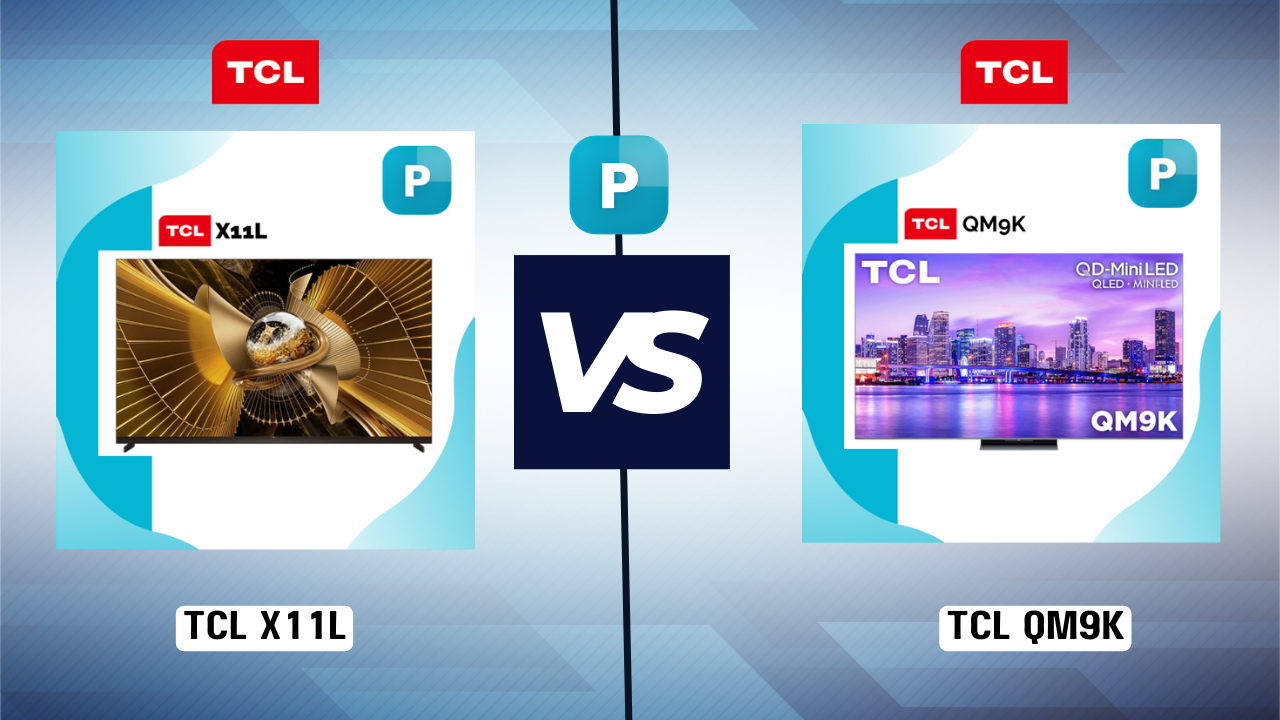
TCL X11L vs TCL QM9K In Depth Comparison

10 views March 14, 2026 Last updated: Mar 15, 2026 7 min read
Login to Save

Detailed Comparison

SpecificationTCL X11LTCL QM9K
Display TechnologySQD-Mini LEDQD-Mini LED
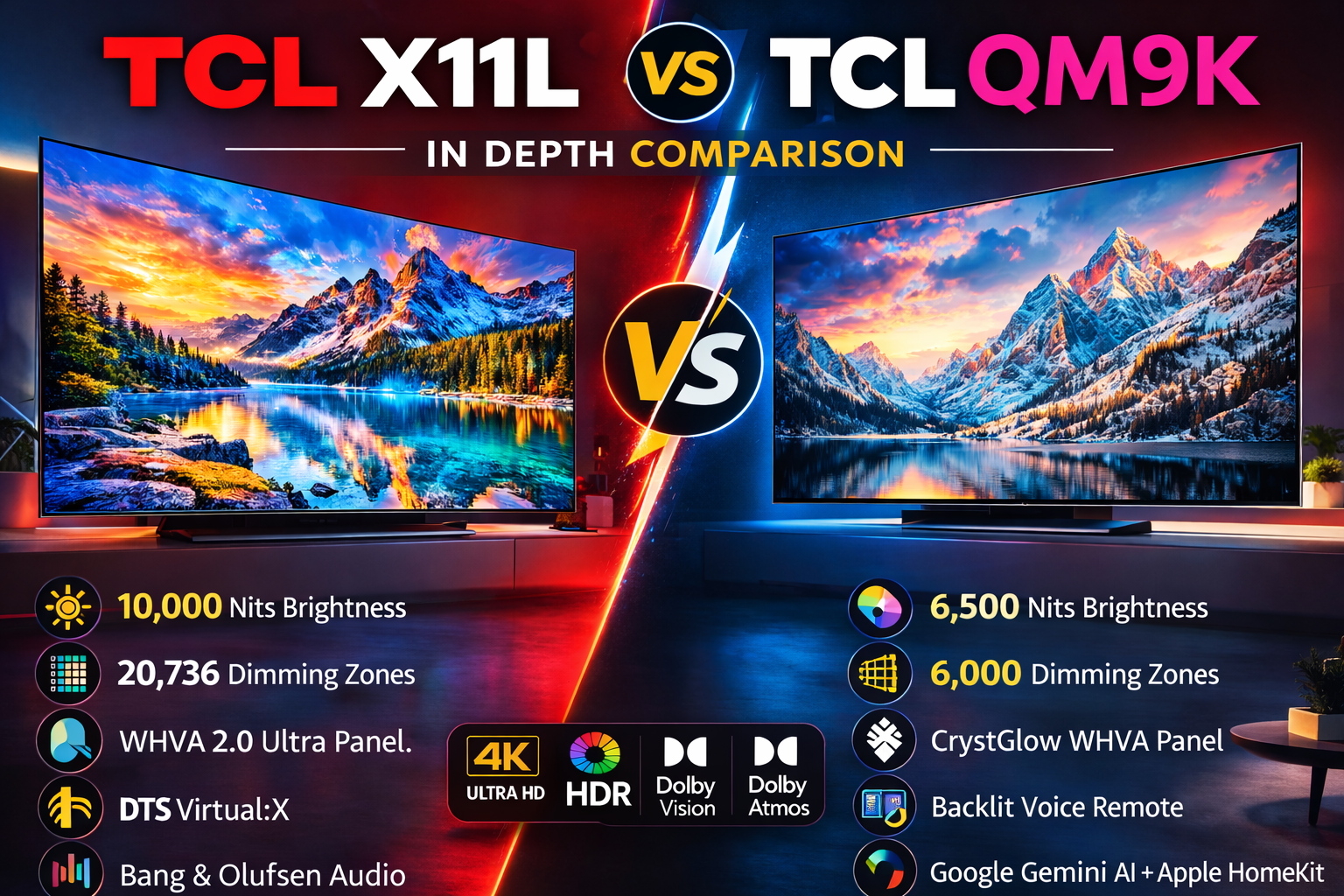
Panel TypeWHVA 2.0 Ultra PanelCrystGlow WHVA Panel
Peak BrightnessUp to 10,000 nitsUp to 6,500 nits
Local Dimming ZonesUp to 20,736 zonesUp to 6,000 zones
Color Coverage100% BT.2020High wide color gamut
Native ContrastNot specified7,000:1
HDR SupportDolby Vision IQ, HDR10+, IMAX EnhancedDolby Vision IQ, HDR10+, IMAX Enhanced
Motion Technology288 Hz VRR Game AcceleratorMotion Rate 480 with MEMC
Gaming FeaturesGame Master Mode, AI Gaming, VRRVRR support
ProcessorTSR AiPQ ProcessorAdvanced TCL Processor
Audio SystemAudio by Bang & Olufsen with Dolby Atmos and DTS Virtual:XAudio by Bang & Olufsen with Dolby Atmos
Operating SystemGoogle TVGoogle TV
Voice ControlHands-free Google AssistantGoogle Assistant, Amazon Alexa
AI FeaturesAI Cinema Mode, AI Art ModeGoogle Gemini AI Integration
Smart Home SupportGoogle ecosystemApple HomeKit, Alexa, Google Assistant
Wireless ConnectivityWi-Fi 6, Bluetooth 5.4Wi-Fi, Bluetooth
HDMI Ports4 ร— HDMI 2.1 with eARC4 ร— HDMI 2.1 with eARC
Available Sizes75", 85", 98"65", 75", 85", 98"
DesignUltra-thin flat design (about 2 cm)Ultra-slim zero-border design
Special Display FeatureExtreme HDR brightness and dimming precisionAnti-reflective screen coating
RemoteStandard voice remoteBacklit voice remote

Full Technical Specifications

Feature TCL X11L SQD-Mini LED TV reviews Specifications TCL QM9K QD-MINI LED TV Reviews Specifications
AMD FreeSync AMD FreeSync Premium Pro -
Additional Features TCL AI, AI Cinema, AI Gaming, AI Art, Ambient Mode, Art Gallery, Gamebar -
Aspect Ratio 16:9 -
Audio System Audio by Bang & Olufsen Audio by Bang & Olufsen
Audio Technology - Dolby Atmos
Auto Game Mode - ALLM with AMD FreeSync Premium Pro
Available Screen Sizes 98 inch, 85 inch, 75 inch -
Available Sizes - 65", 75", 85", 98"
Backlight Technology - TCL Halo Control System
Bluetooth Bluetooth 5.4 -
Certification - IMAX Enhanced
Color Gamut Up to 100% BT.2020 -
Color Technology - Enhanced QLED Quantum Dot Technology
Design Flat-thin design (about 2 cm at thinnest point) Ultra Slim Design with Virtually ZeroBorder
Digital Tuner - ATSC 3.0 NextGen TV Digital Tuner
Dimming Zones - Up to LD6000 Precise Dimming
Display Technology - QD-Mini LED with Quantum Dot
Dolby Atmos Yes -
Extra Features - Ambient Mode Sensor, 350+ Built-in Artwork Gallery
Gaming Features Game Master Mode, 288Hz VRR Game Accelerator Game Accelerator 288 VRR
HDMI Ports 4 ร— HDMI 2.1 4 HDMI Inputs (including 1 with eARC)
HDR Formats Dolby Vision IQ, Dolby Vision, HDR10+, HDR10, HLG -
HDR Support - HDR Ultra, Dolby Vision IQ, HDR10+, HDR10, HLG
Hands-free Voice Control Yes -
IMAX Enhanced Yes -
Local Dimming Zones Up to 20,736 Precise Dimming Zones -
Model 98X11L -
Motion Technology - Motion Rate 480 with MEMC Frame Insertion
Native Contrast Ratio - Up to 7000:1
Operating System Google TV Google TV Smart OS
Panel Resolution 3840 ร— 2160 -
Panel Type WHVA 2.0 Ultra Panel CrystGlow WHVA Panel
Peak Brightness Up to 10,000 nits Up to HDR6500 Nits
Processor TSR AiPQ Processor TCL AIPQ Pro Processor
Refresh Rate 144Hz Native (VRR 48โ€“288Hz / DLG 288Hz) 144Hz Native Refresh Rate
Resolution 4K UHD 4K Ultra HD (3840 ร— 2160)
Screen Treatment - Anti-Reflective Screen
Series X11L TCL QM9K Series
Smart Features - Google Gemini AI Integration
Sound Technology DTS Virtual:X -
Streaming Features - Google Chromecast Built-in, Apple AirPlay 2
Technology Type SQD-Mini LED -
Voice Assistant Google Assistant Built-in -
Voice Assistant Compatibility - Amazon Alexa, Google Assistant, Apple HomeKit
Voice Control - Hands-Free Voice Control with Backlit Voice Remote
Wi-Fi Wi-Fi 6 -
Wireless Connectivity - Wi-Fi 6, Bluetooth Personal Audio
Wireless Display Miracast -
Year 2026 -
eARC / ARC Yes -

Comparison Overview

TCL X11L vs TCL QM9K In Depth Comparison

When buyers hunt for the ultimate big-screen Mini LED experience in 2026, the TCL X11L vs TCL QM9K In Depth Comparison stands out as the most important decision. Both models push QD-Mini LED technology to new limits, yet they differ in brightness, dimming precision, panel refinement, and future-proof features. This detailed breakdown covers every key aspect so you can choose the right TV for your living room.

Design and Build Quality

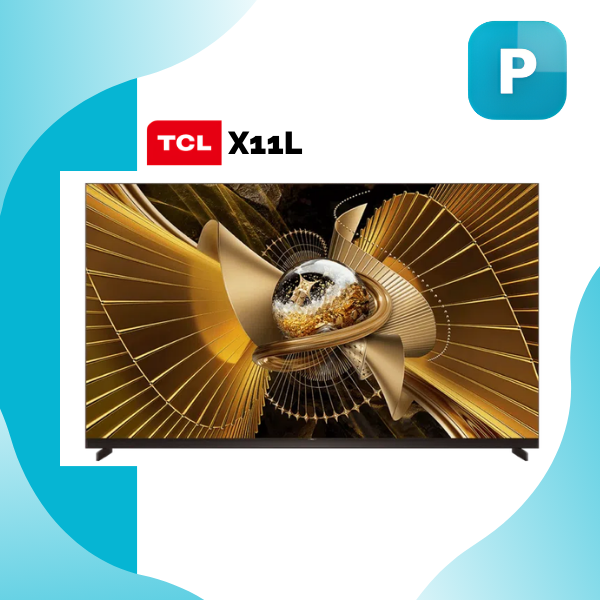
The TCL X11L arrives with a stunning flat-thin design that measures just 2 cm at its thinnest point, giving it an almost frameless floating appearance on the wall. Its available sizesโ€”75-inch, 85-inch, and 98-inchโ€”target enthusiasts who want maximum immersion without compromise. The chassis feels premium and stable, with clean cable management that keeps the setup tidy.

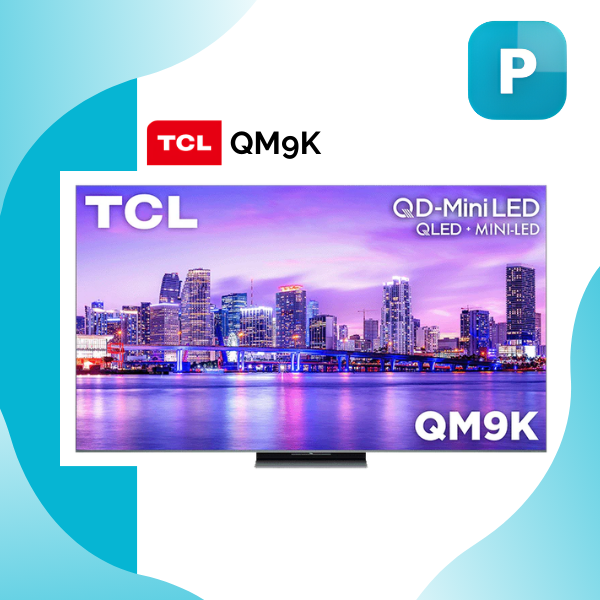
In contrast, the TCL QM9K Series offers an ultra-slim profile with a virtually zero-border look across 65-inch, 75-inch, 85-inch, and 98-inch options. It includes an anti-reflective screen treatment that fights glare in bright rooms far better than most competitors. The QM9K also ships with a backlit voice remote that feels more premium in daily use.

Both TVs mount easily and support ambient mode for displaying artwork when not in use. However, the X11Lโ€™s thinner profile wins for wall-mount purists, while the QM9Kโ€™s anti-reflective coating makes it more versatile in sunlit spaces. Overall build quality feels equally solid on both, but the extra size flexibility and glare control give the QM9K a slight edge for everyday households.

Display Technology and Visual Performance

Picture performance separates these two flagships more than anything else. The TCL X11L uses SQD-Mini LED backlight with a WHVA 2.0 Ultra Panel and up to 20,736 precise local dimming zones. Its peak brightness reaches an astonishing 10,000 nits, and color coverage hits 100 % BT.2020. This combination delivers reference-level HDR with deep blacks, zero blooming in complex scenes, and highlights that truly pop off the screen. Dolby Vision IQ, HDR10+, and IMAX Enhanced certification complete the package, making every movie night feel cinematic.

The TCL QM9K relies on QD-Mini LED with the CrystGlow WHVA panel and up to 6,000 dimming zones. Peak brightness tops out at 6,500 nitsโ€”still excellent but noticeably behind the X11L in the brightest HDR moments. Its native contrast reaches 7,000:1, and Motion Rate 480 with MEMC keeps sports and fast action smooth. Both support the same HDR formats, yet the X11Lโ€™s higher zone count and brightness create more accurate light control, especially in dark rooms with small bright objects like stars or streetlights.

Color accuracy and upscaling are strong on both thanks to their advanced processors, but side-by-side the X11L shows richer gradients and better shadow detail. If you crave the absolute best contrast and brightness for premium content, the X11L pulls ahead clearly. For most viewers watching in mixed lighting, the QM9K still impresses and costs less per inch in smaller sizes.

Audio Performance and Smart Features

Audio hardware is identical at first glanceโ€”both carry the respected Audio by Bang & Olufsen system with Dolby Atmos support. The X11L adds DTS Virtual:X for wider virtual surround, which creates a more immersive soundstage during action sequences. Dialogue remains clear on both even at higher volumes, and built-in woofers deliver solid bass without needing a separate soundbar immediately.

Smart platform is Google TV on each model, yet implementation differs. The TCL X11L includes hands-free voice control and the standard Google Assistant, plus dedicated AI Cinema and AI Art modes that automatically optimize content. The TCL QM9K steps up with Google Gemini AI integration, Apple HomeKit compatibility, and a broader voice assistant lineup including Amazon Alexa. Its Chromecast and AirPlay 2 support feel seamless for multi-device homes.

Connectivity matches perfectly: four HDMI 2.1 ports with eARC, Wi-Fi 6, Bluetooth 5.4 on the X11L, and similar specs on the QM9K. The X11L edges forward with its TSR AiPQ Processor that handles AI Gaming and AI upscaling more aggressively. Both TVs feel responsive, but the QM9Kโ€™s Gemini features make daily voice commands slightly more natural. If you value pure audio immersion and future AI picture modes, the X11L wins; for smart-home integration, the QM9K shines.

Comparison Reviews

Early hands-on comparison reviews of the TCL X11L vs TCL QM9K In Depth Comparison highlight how close these TVs sit in the premium segment. Testers praise the X11Lโ€™s jaw-dropping 10,000-nit brightness and massive dimming zone count for delivering the most lifelike HDR they have seen in 2026. Gamers appreciate the 288 Hz VRR Game Accelerator and Game Master Mode that keep input lag under 10 ms. Reviewers note the X11L feels like a true flagship upgrade, especially in 98-inch form where bloom-free blacks transform movie viewing.

The QM9K earns consistent praise in comparison reviews for its anti-reflective screen and Motion Rate 480 smoothness, making it ideal for bright living rooms and sports fans. Its Gemini AI and backlit remote receive frequent โ€œconvenience winnerโ€ mentions. However, several side-by-side tests show the QM9K cannot match the X11Lโ€™s peak brightness or zone precision during demanding scenes from titles like โ€œDuneโ€ or โ€œThe Batman.โ€ Value-focused reviewers point out the QM9Kโ€™s lower price per inch and extra 65-inch option make it more accessible for families.

Overall comparison reviews agree both TVs deliver flagship performance, but the X11L consistently scores higher in picture benchmarks while the QM9K wins on usability and glare control. No major reliability issues surfaced in early testing for either model.
Final Verdict

After weighing every specification, performance metric, and real-world scenario, the TCL X11L emerges as the superior choice for enthusiasts who demand the brightest, most precise Mini LED picture available in 2026. Its 10,000-nit peak, record-breaking dimming zones, and WHVA 2.0 panel simply outperform the QM9K in contrast, HDR impact, and gaming smoothness. If you own a dedicated home theater or plan to buy the 85-inch or 98-inch size, the X11L delivers unmatched value despite the premium price.

Choose the TCL QM9K if you need the 65-inch option, prioritize anti-glare performance in sunny rooms, or want deeper smart-home integration with Gemini AI. It remains an outstanding TV that will satisfy 95 % of buyers and still outperforms most competitors.

In the end, this TCL X11L vs TCL QM9K In Depth Comparison proves TCL continues raising the bar. For pure performance, pick the X11L. For balanced everyday excellence, the QM9K is hard to beat. Either way, you are getting one of the best Mini LED experiences money can buy right now.

Community Choice

Which one would you choose?

0%
0%

User Feedback

Leave a comment

Recent Feedback (0)

No feedback yet

Be the first to share your thoughts!

Frequently Asked Questions

Which TV has the better picture quality, the TCL X11L or TCL QM9K?

The TCL X11L has superior picture quality, especially for HDR content. Its key advantage is a staggering 10,000-nit peak brightness and over 20,000 local dimming zones, which delivers unparalleled contrast, deeper blacks, and eliminates blooming. The QM9K is still excellent with 6,500 nits, but the X11L is in a higher league for pure performance.

What are the main differences in screen technology?

The TCL X11L features a SQD-Mini LED backlight with a WHVA 2.0 Ultra Panel and up to 20,736 dimming zones. The TCL QM9K uses a QD-Mini LED with a CrystGlow WHVA panel and up to 6,000 dimming zones. The X11Lโ€™s panel is more advanced, resulting in significantly higher brightness and more precise light control.

Which TV is better for a very bright room?

The TCL QM9K is the better choice for a very bright room. It features a superior anti-reflective screen treatment that fights glare exceptionally well. While the X11L gets much brighter, the QM9K's glare control makes it more versatile in sunlit spaces.

Which TV has better built-in audio?

Both TVs feature excellent Audio by Bang & Olufsen systems with Dolby Atmos. However, the TCL X11L has a slight edge as it adds DTS Virtual:X, which creates a wider, more immersive virtual surround sound experience for movies and action sequences.

What are the key smart features and differences?

Both run on Google TV. The TCL QM9K features newer integrations, including Google Gemini AI for more natural voice commands and Apple HomeKit compatibility. The TCL X11L focuses on dedicated AI modes like AI Cinema and a powerful TSR AiPQ Processor for aggressive AI upscaling.

Which TV is better for gaming?

Both are exceptional for gaming, with four HDMI 2.1 ports. The TCL X11L has a minor advantage with its 288 Hz VRR Game Accelerator, which can push frame rates even higher for competitive PC gaming, and its Game Master Mode keeps input lag under 10ms.

Is the TCL X11L worth the higher price?

Yes, for home theater enthusiasts who demand the absolute best picture. The X11L's 10,000-nit brightness and massive dimming zone count provide a reference-level HDR experience that is visibly superior, especially in dark rooms on larger screens like 85 or 98 inches.

Which TV is the better value for most people?

The TCL QM9K is the better value for most households. It offers incredible flagship performance, excellent glare handling, and the latest smart features (Gemini AI) at a more accessible price point, and itโ€™s available in a more versatile range of sizes, including a 65-inch option.

In what screen sizes are these TVs available?

The TCL X11L is available in 75-inch, 85-inch, and 98-inch sizes. The TCL QM9K offers more flexibility with 65-inch, 75-inch, 85-inch, and 98-inch options.